
Using the reference point of only a single item, try to define the following words: better, best, loud, tall, hot, rough.
When you create that description, ask yourself: what is “better,” “loud,” or “rough”?
I suspect you could provide some definition, but it would either be stronger with a comparison—or you already snuck one in without realizing it.
When we analyze something, it’s often by comparing it to a known quantity. That gives us two elements: first, a reference point—something known, so we can create a mental picture of where we are—and second, a contrast to that reference point.
For example, if we say something is loud, we each may have an idea of what that means. But our impressions can be very different. If the reference point is outer space, where there’s essentially no sound, then the flutter of a butterfly’s wings might qualify as “loud” by comparison. On the other hand, compared to a jet engine, that same butterfly is certainly not “loud.”
Contrast
What makes these two descriptions of “loud” similar yet different? The contrast between two different states. You can demonstrate this in most cases with a simple follow-up question:
Compared to what?
By using a known reference point, we can better agree on what is “loud,” “tall,” or “rough.” Maybe not perfectly, but certainly closer than without the comparison.
It’s the contrast between two elements that matters—the defined difference that gives us understanding. Everything boils down to contrast, which is a form of comparison.

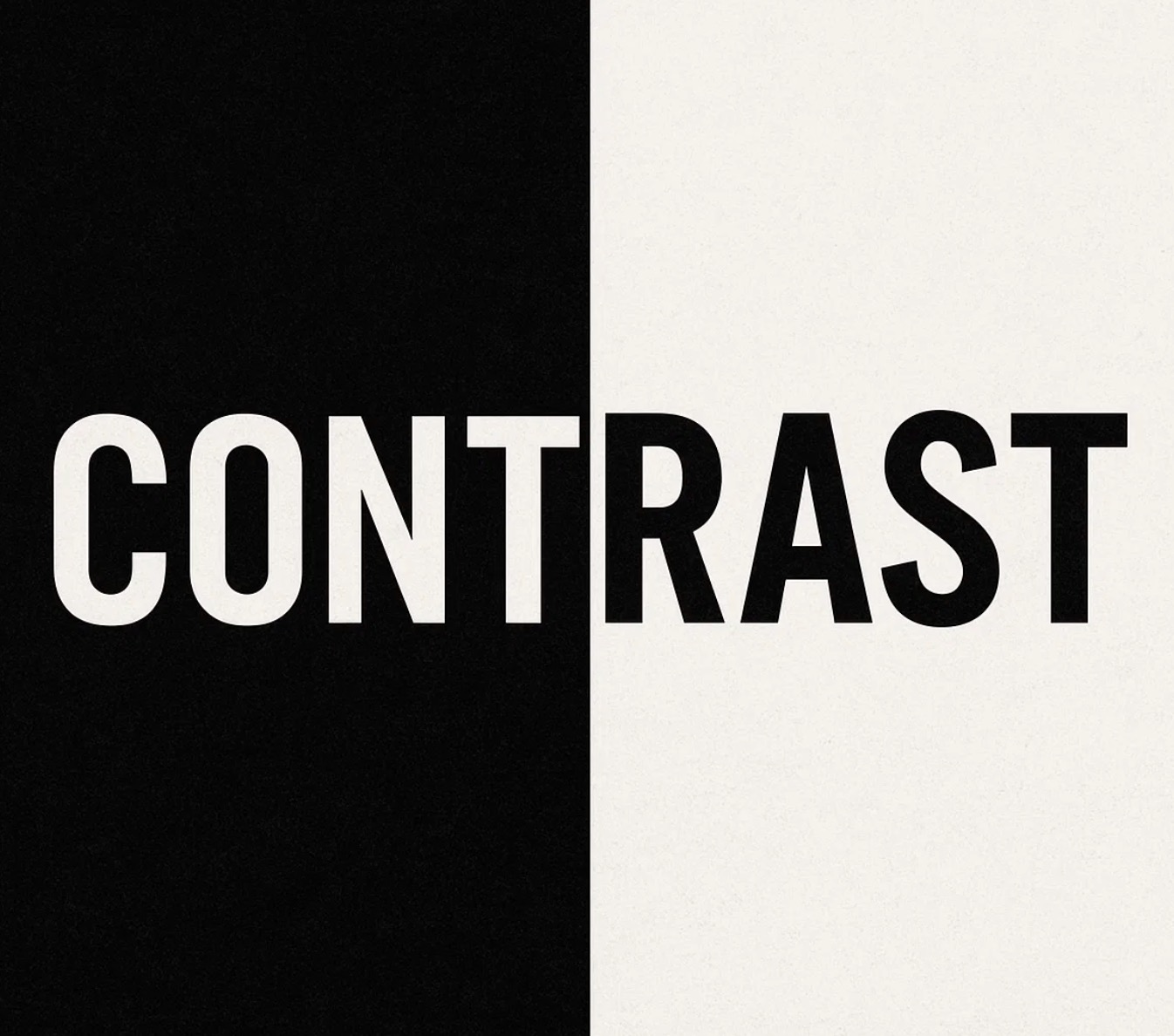
Our eyes detect sharp contrasts in color and texture. Outlines of objects differ from their surroundings, allowing us to “see” and identify them. If there’s no light in a room, we can’t see the contrast between objects (chairs, tables, etc.). Much like trying to see black letters on a black background: the letters still exist, but without light we can’t perceive them—until we provide contrast.
Vision isn’t the only way to determine contrast and identify objects. Touch works too. If we can feel objects, we can often classify them. We know what a chair is; we can feel the difference between fabric and wood or metal. The coolness of a hard surface provides sensory feedback that hints at material. Once again: sensory contrast.
Contrast Is Not Static
We often think our reference point is rock-solid. It never changes.
Sometimes that’s true. More often, reference points shift—and with those shifts, our perceptions change.
Consider your lawn and your neighbor’s. Both look great; not much difference. You’re happy with your curb appeal. Then your neighbor (that rascal) fires up the mower. You return from an errand and now see the contrast: their lawn is freshly cut and trimmed. Suddenly yours doesn’t look so good—even though nothing changed with your lawn while you were away.
Your contentment shifts to discontent. Not because your lawn changed, but because your reference point changed, creating a new contrast.
A day later, you cut your lawn. Now yours looks neat and trim—better than your neighbor’s, which has grown. The reference points have changed again; so has the contrast. Now you have the enviable lawn. Perception swings with the reference point.
Your neighbor gets home and has the same emotional response you had. They mow. The cycle repeats—again and again, all summer long. Each of you alternates between neat and shaggy (yes, exaggerated), as reference points keep changing. Your perception—your sense of contrast—keeps cycling between satisfaction and dissatisfaction.
Contrast can swing back and forth, nudging you to act in ways that reduce the contrast in your favor.
Using Contrast to Our Advantage
Contrast can be a tool—a ThoughtCrafting tool.
How?
We know contrast can trigger subconscious judgments that influence conscious decisions. By tapping into that process, we can shape our actions.
Losing weight. One simple tactic: use a smaller plate. Your portions will look bigger. Your subconscious registers “a full plate,” whether it’s six inches or nine. Over time, your subconscious adjusts. Ditto with a smaller fork: you’ll take smaller bites, more cycles, and likely feel just as satisfied while eating less. Simple, effective.
Writing more. If you measure output by pages, start at 12-point text. After a while, drop to 11.5, then 11, then 10. Your subconscious keeps chasing “a page or two,” but each page now contains more words. Voilà—more writing with the same perceived effort.
What’s the Lesson?
Contrast often drives us to act—sometimes wisely, sometimes wastefully. We do things that consume time and resources without moving us toward our goal.
It’s time to take charge and think about our response to contrast, rather than letting the subconscious run the show. Understand the role contrast plays in your decisions. When you feel that emotional punch, pause and consciously consider your next move. Respond deliberately, not on reflex.
Use contrast to guide your subconscious in a productive direction that you control. Help your subconscious make you more productive—better, happier.
Use the ThoughtCrafting tool “Contrast” to identify the Situation, notice the Trigger, Interrupt the reflex, apply the ThoughtCrafting Tool, Craft the new action, and Harvest the benefit.
And about those lawns: if you and your neighbor simply cut them on the same day, both will look good as they grow together. You’ll both cut less often—and enjoy the appearance longer between cuts.
STITCH Framework Example:
-
Situation: You notice a sudden sense of dissatisfaction after seeing someone else’s “better” version of something you already liked — their trimmed lawn, new phone, or updated website.
-
Trigger: That internal twinge — a drop in satisfaction or a sense of competition — appears.
-
Interrupt: Pause before reacting. Ask, “Compared to what?” Identify whether your feeling comes from real decline or just a changing reference point.
-
ThoughtCrafting Tool: Use Contrast to reframe. Recognize that your perception shifted only because the comparison shifted.
-
Craft the Change: Re-center your reference point. Choose your own benchmark of progress or satisfaction — one you control.
-
Harvest: Experience renewed contentment and control. You’ve redirected an external contrast into an internal compass.



Responses